Tribute in Memory of Prince Olasehinde Odimayo
Published 13 October 2026 in Bulletin
Uche Okeke Legacy Editorial
Odimayo, as we fondly call him, was introduced to our family by Ijeoma Uche-Okeke. He was already a familiar name by the time I met him in 2001, and I remember being struck by his gentleness, great depth of understanding, and spirituality - qualities that he continued to evolve and nurture over the time I knew him.
I will never forget the numerous discussions we had regarding spirituality after our father passed away. He mentioned that although he never actually met our father, he always felt a deep connection with him. He was very drawn to the Uche Okeke Legacy project and, over the years, remained a fountain of inspiration to Ijeoma and myself. His near-death experience helped to deepen his understanding of the meaning of life, and he will forever be a real source of inspiration to many. I know he worked furiously in the last couple of years to document his journey and put his voice out there.
In the period after Ijeoma’s passing, Odimayo’s words were a balm of healing for me. I want to thank Omooba Yemisi Shyllon for the opportunity to see Odimayo one last time in the Ikoyi hospital when I visited with my mom and my brother, Chuma. Looking at him then, I knew that things would never be the same again. I am also grateful to Nana Asumah, and many others, for all the care provided to him.
I like to imagine that the transition was as beautiful as his soul. I pray that he is now in the company of all his departed loved ones, including Ijeoma, in a much better place.
We refuse to be out of mind because you are out of sight. Until we meet again, sir.
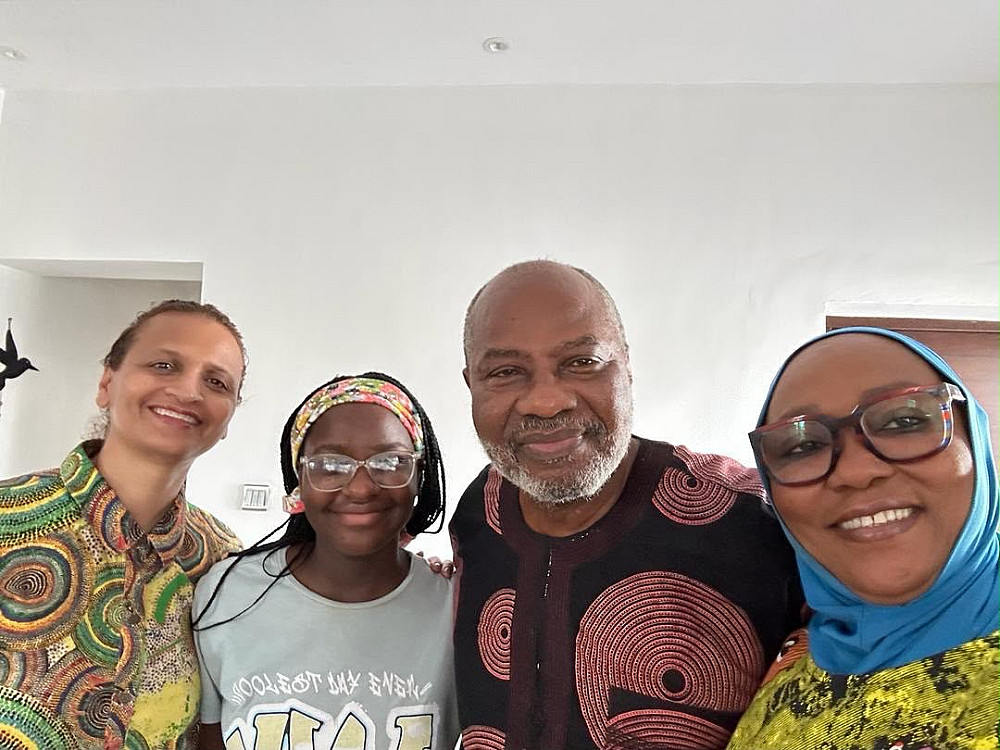
Please also find his obituary and a photo taken with him attached for additional context. Let me know your thoughts once you've had a chance to look this over.
Salma Uche-Okeke
The passing of Prince Olasehinde Odimayo on 17 June 2026 marked the loss of an important figure within Nigeria’s art community. A pioneering gallerist, collector, art patron, and cultural advocate, his life was shaped by a deep commitment to Nigeria's artistic heritage and to the people responsible for carrying it forward.
For the Uche Okeke Legacy, however, his significance was also deeply personal. His connection to the family, his affinity with Professor Uche Okeke and his legacy, and his friendship with Ijeoma and Salma Uche-Okeke meant that his relationship with UOL extended beyond a shared professional interest in Nigerian art. It was grounded in friendship, reflection, and a mutual belief that cultural legacy must be actively preserved, understood, and passed from one generation to the next.
A Life Dedicated to Nigerian Art
Born on the 2nd December 1949, Prince Olasehinde Odimayo lived much of his life in close conversation with art, and would become a longstanding figure in Nigeria’s art world. He spent much of his life advocating for Nigerian art and the foundational traditions that birthed what it has become today, leaving a rich and formative legacy that will never be forgotten.
As Director of Treasure House Fine Arts, he helped create a space where artists, collectors, scholars and art lovers could meet, exchange ideas and engage with Nigerian art, aiding in not just the growth of the market, but the upliftment of its spirit and reception. He was, of course, a renowned collector and advocate of Nigerian arts and culture, and supported exhibitions, mentored artists and championed initiatives concerned with the country’s heritage - but he was more than just a gallerist. For Odimayo, art was a lens through which one could understand the very identity of a nation and its people.

Nok Sculpture, Louvre, CherryX, Wikimedia Commons
That relationship between past and present was fundamental to his work and life, and is what made him so akin to Uche Okeke. Like Okeke, Odimayo understood tradition as something living, not something to be placed at a distance or treated only as history. It could and should continue to inform how artists think, make, and understand their place in the world. It should inform a holistic practice fuelled by all parts.
Preservation as a Responsibility
With Odimayo’s appreciation and understanding of Nigeria’s artistic inheritance came a strong awareness of its vulnerability.
Odimayo was vocal about the misinformation surrounding Nigerian art as well as the trafficking of valuable cultural artefacts. He advocated education and greater awareness as essential parts of protecting that heritage, and was a firm believer in repatriation and the need for greater fairness and balance in relation to displaced cultural material. For Odimayo, preservation will always be tightly connected to knowledge. It’s not enough for artworks or artefacts to simply survive. Their histories need to be researched. Their stories need to be documented. People need opportunities to understand why they mattered, and to be inspired by them.
This conviction also shaped his outlook towards younger generations. He believed that education and mentorship that embody this philosophy, in tandem with the necessary research and documentation, are key to a proper foundation from which they should be taught. This is how we ensure that the value and experience of our traditions can be properly instilled and carried forward into future generations. This is how we ensure that knowledge of Nigerian art, culture, and history remains accessible to those who inherit it.

Human head, Nigeria, Ife, 12th–15th century, Terracotta, 19cm (Ethnological_Museum_of_Berlin), Wikimedia Commons

It was this ideology that he carried in everything he did, and he championed it with genuine care, love, and consideration for all aspects that made up Nigeria’s creative spirit. He recognised that art is not only a vital means of expression, but holds the very stories and essence of where we have come from – our history, traditions, and very spirit itself. He believed that this is key to the foundation we should build on for Nigerian art to be authentically uplifted and carried forward.
This concern with cultural memory - and indeed, what might be lost if the surrounding knowledge is neglected - is one of the clearest threads at the forefront of Prince Odimayo’s legacy, and is a concern he would urge us to continue to carry. It was this, amongst many things – his gentle spirit, his depth of understanding, and his belief in the spirit of Nigeria and Nigerian art – that connected Prince Odimayo and the Uche-Okeke Family so keenly.
Looking Back to Carry Forward
When Prince Odimayo joined Salma Uche-Okeke and Tamzin Lovell for an episode of Coffee & Uche Okeke in March 2024, the conversation gave insight into just how deeply his belief in cultural memory ran. Although concerned with the contemporary art market, Odimayo looked far beyond it – the root of his legacy was and will always be a need to understand Nigerian art through its historical and traditional foundations.
He spoke about the vitality in recognising the inherent value of traditions, referencing those of Nok, Ife and Benin, which have deep and ancient roots in our nation and psyches, and how rich the art is of those such as El Anatsui, who embrace and draw much inspiration from this ancestral root. Odimayo didn’t believe this understanding to be of such importance because he thought Nigerian art should remain stagnant in its past. Rather, he believed that cultural knowledge acts as a rich soil from which new artistic ideas can emerge - ones that embody all that the artist, a nation, an art form, is. Ones that carry the past and present, the traditional and modern, the root and the new growth.

Benin Bronze, Bust of an Ooni of Ife, arts-primitive.com, Wikimedia Commons
These beliefs found practical expression across his professional life, and Treasure House Fine Arts was just one avenue through which he applied this. He was so much more than simply a collector and gallerist concerned with the art market. He was an inspiring force of high esteem, one that relentlessly worked in so many ways to ensure Nigerian art is seen, valued, understood, and remembered for what it truly is - all with a deep undercurrent of his kind, caring, and gentle spirit.
A Legacy to Carry Forward
This is perhaps where the significance of Prince Olasehinde Odimayo’s life becomes clearest.
There is the tangible legacy of a career devoted to Nigerian art: the artists he supported, the works he collected, the exhibitions and initiatives he championed, and the contribution of Treasure House Fine Arts to the country's artistic community.
But there is another legacy too. It exists in his insistence that cultural knowledge matters. It exists in his belief that younger generations should be given the knowledge and encouragement necessary to engage meaningfully with their heritage. It exists in the importance he placed on research, documentation, and repatriation to ensure that history and tradition are not lost and are accessible to its people. And it exists in his conviction that Nigeria’s artistic inheritance should not simply be admired as a remnant of the past, but understood as a foundation for what comes next.
Odimayo’s work sits so naturally alongside that of Uche Okeke and UOL. The preservation of an archive; the documentation of not just one man’s life and thinking, but a movement that he devoted himself to; the encouragement of research and education to support and enable future generations, and the creation of ways for them to access their cultural history. These all depend upon the same fundamental belief: legacy survives when knowledge is passed on.
Prince Olasehinde Odimayo keenly understood this. It was this, amongst many things, that he shared with the Uche Okeke Family.
There is particular poignancy now in knowing that he also sought to document his own journey and put his own voice into the world. The Coffee & Uche Okeke conversation has become part of that record. This conversation was recorded just over two years before his passing, and it now allows us to return not simply to information about Odimayo, but to Odimayo himself: discussing Nigerian art, reflecting on history, considering what has been lost and preserved, and looking towards the generations who would inherit this cultural landscape.
That feels particularly meaningful now.
Prince Olasehinde Odimayo passed away on 17 June 2026. What he spent a lifetime advocating for, however, remains an unfinished and shared responsibility: to know our histories, to preserve them carefully, to make them accessible, and to ensure that the knowledge entrusted to one generation is not lost to the next.
In that continuing work, his contribution endures.
May his gentle soul rest in perfect peace.
Listen to S2EP1 – Coffee & Uche Okeke with Prince Olasehinde Odimayo.

Prince Olasehinde Odimayo and the Uche-Okeke Family