Archive in Motion - Taller Together Podcast interviewed Salma Uche-Okeke
Published 09 February 2026 in Collaborations
Armature Magazine
The Archive in Motion: Reframing Uche Okeke’s Legacy for the Present
Originally published in Taller Together Podcast
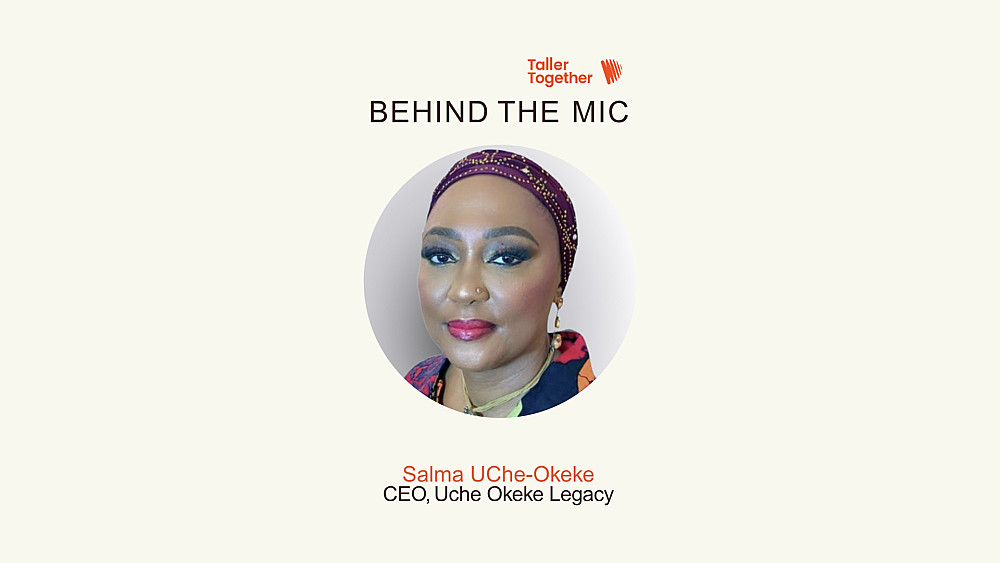
In a recent episode of Taller Together, hosted by Tamzin Lovell, Salma Uche-Okeke offers a compelling reflection on what it means to sustain an artistic legacy in the contemporary moment. The conversation moves beyond biography and into a more urgent terrain: the structures, decisions, and responsibilities that determine whether an artist’s work continues to live, circulate, and speak.
At its core lies a deceptively simple premise: an artist’s work does not endure by default. It survives because it is actively sustained.
Legacy as Practice, Not Inheritance
Uche Okeke is widely regarded as a foundational figure in Nigerian modernism, and a central architect of what would later be theorised as Natural Synthesis within the Nsukka School. Yet, as Salma Uche-Okeke makes clear, such recognition does not guarantee continuity.
Legacy is not a passive inheritance. It is a form of labour.
To steward Okeke’s work is to engage in an ongoing process—legal, intellectual, and cultural. It involves decisions about authorship, interpretation, and access. It also requires confronting a fundamental shift: once the artist is no longer present to authenticate or contextualise their work, authority must be reorganised.
This is what it means, in a deeper sense, for a legacy to “argue back.” It resists closure. It demands structure.
From Archive to Institution
One of the most instructive aspects of the discussion is the emphasis on institutional form. The Uche Okeke Legacy operates through a dual structure: the Asele Institute (as a non-profit entity) and a family-led holding company.
This model reflects a broader truth often overlooked in discussions of African modernism: archives are not neutral repositories. They are systems of governance.
They determine:
- who has the authority to authenticate works
- how images are licensed and circulated
- what narratives are stabilised or contested
- how scholars, collectors, and institutions engage with the work
In this sense, the archive becomes an extension of the artist’s intellectual project. For Okeke—whose practice insisted on the continuity and transformation of indigenous forms such as uli—this is particularly significant. The archive must remain dynamic, not static; interpretive, not merely preservational.
The Politics of Recognition
A recurring challenge highlighted in the conversation is the incomplete recognition of artist estates, particularly within African contexts. Institutions and collectors often continue to operate as though the artist remains the sole authority, even after their passing.
This creates a structural tension: the estate is tasked with stewardship, yet must simultaneously assert its legitimacy.
Such conditions reveal a gap in the global art ecosystem. While Western art histories have long institutionalised the role of estates, many African legacies are still negotiating this terrain in real time, often without sufficient legal or infrastructural support.
Activation vs Preservation
A particularly generative thread in the discussion concerns the distinction between preservation and activation.
To preserve an archive is to protect it.
To activate it is to make it speak.
For Uche Okeke’s work, this distinction is critical. His artistic philosophy was never about static tradition, but about transformation - what he termed a living synthesis between indigenous knowledge systems and modern artistic practice.
To honour that philosophy, the archive must remain in motion.
This includes:
- scholarly research and publication
- exhibitions and curatorial interventions
- pedagogical engagement
- digital dissemination
Without such activation, the archive risks becoming inert-detached from the very cultural logic that produced it.
Technology as Amplifier
The conversation also addresses the role of digital tools, particularly in partnership with platforms such as Artfundi. Here, technology is framed not as a solution, but as an amplifier.
Digital systems can:
- expand access
- improve documentation and metadata
- support global visibility
However, they also reproduce existing values. A poorly structured archive, when digitised, does not become coherent - it becomes more widely incoherent.
Thus, questions of rights, authorship, and access remain central. Technology does not resolve these issues; it intensifies them.
Leadership and Collective Stewardship
Salma Uche-Okeke’s reflections on leadership are notably pragmatic. Legacy-building is not driven by singular vision alone, but by networks of collaboration - legal experts, archivists, scholars, technologists, and cultural institutions.
This resonates strongly with the ethos of the Nsukka School itself, which emerged not as an isolated movement but as a collective intellectual environment.
The lesson here is clear: sustainable legacies are built through partnership, not individual heroics.
Holding Complexity: The “Primeval Beast”
The conversation concludes with a return to the work itself, specifically, Uche Okeke’s Primeval Beast. The image, with its ambiguous, almost unsettling form, resists easy interpretation.
This is an apt metaphor for the legacy as a whole.
A meaningful archive does not simplify. It preserves contradiction. It allows the work to remain intellectually and emotionally alive, capable of generating new readings across time.
In this sense, the task of the Uche Okeke Legacy is not merely to conserve the past, but to sustain a field of inquiry.
Conclusion
The notion of “the archive in motion” offers a powerful framework for thinking about artistic legacies in Africa and beyond. It insists that preservation alone is insufficient. What is required is an active, structured, and ethically grounded engagement with the work - one that remains responsive to changing contexts while rooted in the artist’s original vision.
For Uche Okeke, whose practice reimagined tradition as a living, evolving force, this approach is not only appropriate, it is necessary.
Source: Armature Magazine - Podcasts
https://armature-mag.art/projects/taller-together-ep-4-salma-uche-okeke-the-archive-in-motion